
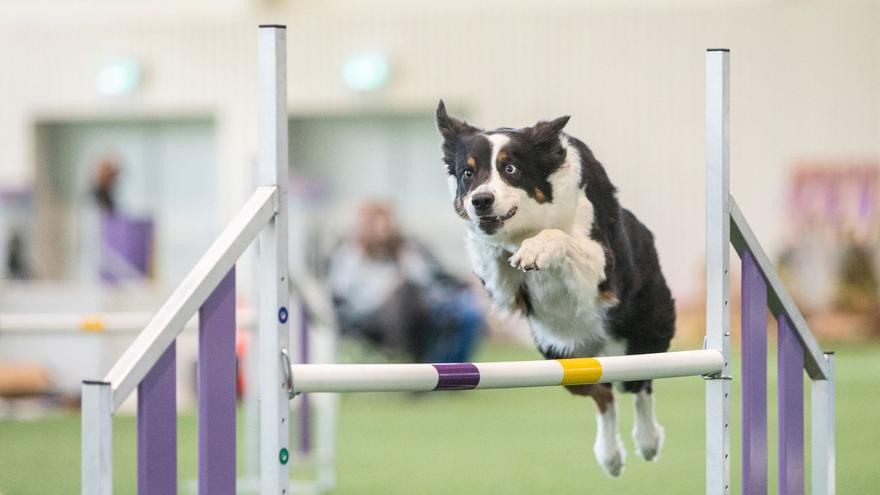
How much do you really need to train to be successful and have fun in today's agility? I sometimes hear complaints about the difficulty of today's courses, and many comments about how much training you need to master them. Of course, all agility dogs and handlers need training to have fun on course, but I don't think that the amount of training has much to do with how successful you are. In my experience, successful teams usually practice less than most average competitors do.
I hear the same thing about young dogs sequencing and looking confident and skillful – "They must have trained so much to get there!" In reality, it takes very few sessions for a young dog with good foundation skills to sequence really nicely. With my young dogs, I haven't felt any rush to train them for competition; rather, it's been taking it easy and waiting for maturity, as their skills quickly catch up with their age.
I don't think it's about the amount of training – it's about the right training. Even if it might sound like I'm saying agility is really easy, and you don't need much training at all, that's not what my point is. Agility is really hard! Even the most well-trained dogs and handlers make mistakes, fall into traps, or struggle to perform when it matters the most. But the solution is rarely more training; it is probably smarter, better training. Making sure we're training the things that really matter, that we're creating clarity and not confusion or conflict, and figuring out our handling before we bring the dog out.
I sometimes end up on the side of too little training. Skills need refreshing, even when they started out really good. Giving my dogs regular reminders on things like running dogwalks and weave entries does make a difference, and I have to remind myself to refresh skills before they suddenly fall apart in competition. But still, it's maybe a session every two months that would be required to keep the skill fresh.
What are my priorities?
- Making sure that my dogs are working with optimal focus and intensity. It looks different for different dogs
- Keeping training short and fun
- Fixing problems at the root instead of trying to fix them when there are a lot of other things happening – back to basics often!
- Analyzing my behavior by watching videos of my training and handling. or asking trusted training friends to give feedback
- Making sure that the dog loves training with me, so that feedback and rewards are more important than just running and taking obstacles in their way
- Knowing what is a handling problem and what is a verbal cue skills problem, and keeping the dog's understanding of the difference clear. If we have a problem, is it because of my bad handling, my dog's lack of understanding/motivation for handling cues, or is it a verbal cue problem?
- Figuring out what verbal cues I really need, and how to define and teach them, rather than training the same cues as everyone else, without a clear picture in mind
- Analyzing what happens in competition, and adjusting my training plan so that I focus on what actually is a problem
- Avoiding the repetition of mistakes – change my behavior quickly to help the dog be correct, and take breaks early and often so I can think through what happened and how I can adjust the plan to see success without teaching the wrong thing
- Never train without a clear plan on what I want to test or improve
- Always make time for long walks in the forest, conditioning, and enough rest between heavy sessions